Gum Tissue Grafting

Cover exposed roots, restore healthy gums, and protect your smile with advanced soft tissue grafts.

Gum Tissue Grafting

What to Expect During Gum Grafting

Your comfort is our priority. Before your procedure, the treatment area will be numbed with a local anesthetic. If appropriate, medication may also be available to help you feel relaxed and comfortable throughout your visit.

The type of gum graft recommended will depend on the location and extent of your gum recession, as well as the amount of available tissue. There are three common types of gum grafts:

Connective Tissue Graft

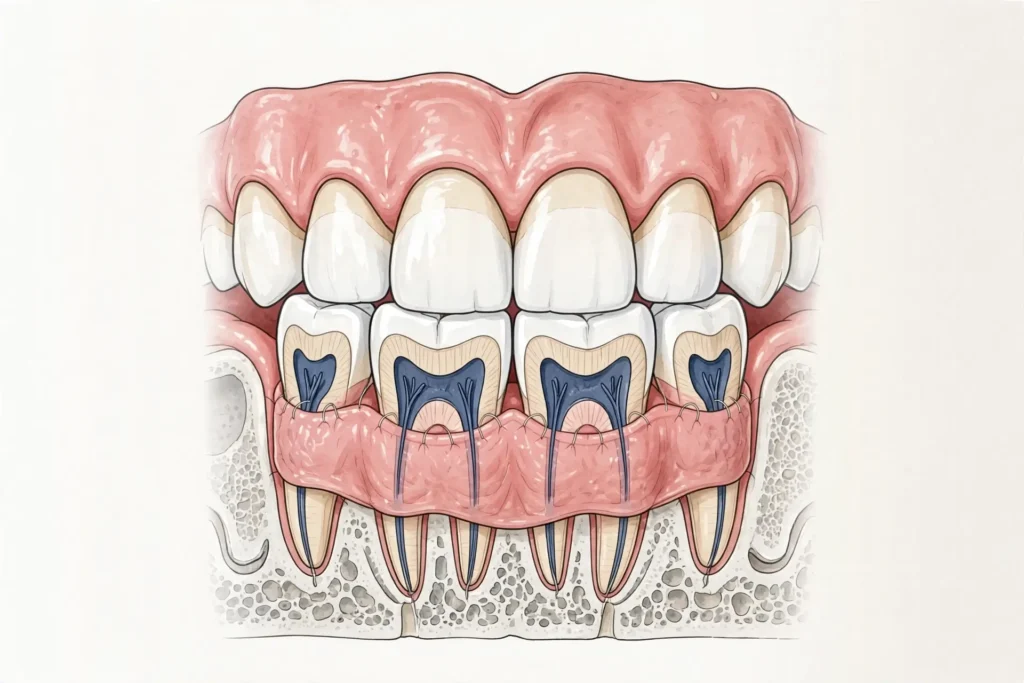
A connective tissue graft is commonly used to cover exposed tooth roots. Tissue is taken from beneath the surface of the roof of your mouth and carefully placed over the area of gum recession. The graft is then secured in place with sutures, and the donor area is closed.

Free Gingival Graft

A free gingival graft uses a small piece of tissue taken directly from the roof of the mouth. The tissue is placed over the area being treated to add thickness and increase the amount of protective gum tissue. This approach is often recommended for patients with naturally thin gums.

Pedicle Graft

A pedicle graft uses gum tissue from the area next to the affected tooth rather than taking tissue from the roof of the mouth. A small section of nearby gum tissue remains attached while it is gently repositioned to cover the exposed root and secured with sutures.

Your periodontist will evaluate your gums and recommend the grafting technique that best fits your individual needs.
Signs you may need treatment
Receding Gums
Sensitive Roots
Loss Of Attached Tissue
Risk Of Decay & Loss

What to expect

1

Diagnose

Gum graft is a beneficial procedure to replace healthy attached tissue around teeth that have lost tissue. We determine which procedure is most beneficial for you based on your gum loss situation. There are different types: Free Gingival Graft, Connective Tissue Graft, Lateral Pedicle, and AlloDerm (acellular dermal matrix without harvesting from palate).

2

Treat

A small layer of tissue is removed from the roof of your mouth (donor site) – except with AlloDerm where no palate tissue is needed – and then relocated to the recipient site of recession. It is sutured into place to serve as living gum tissue. Dr. Farhadian will discuss the best option to treat gum recession around teeth and implants.

3

Restore

The grafted tissue covers unattractive roots, reduces recession, and protects roots from decay and eventual loss. It replaces healthy attached tissue and integrates as living tissue, restoring both esthetics and function and preventing further gum loss.

Common questions

What is a gum tissue graft?
It is a soft tissue graft used as a cosmetic and protective procedure. It covers exposed roots, reduces recession, and protects roots from decay and loss. Tissue from the palate or AlloDerm donor material is sutured over the recession to become living gum tissue.
There are different types for different situations of gum loss: Free Gingival Graft, Connective Tissue Graft, Lateral Pedicle grafts, and Alloderm (acellular dermal matrix) which does not require harvesting tissue from your palate. Dr. Farhadian will determine which is best for you.
It is beneficial to replace healthy attached tissue lost due to aggressive tooth brushing, orthodontic treatments, or other reasons. It is needed when recession exposes roots causing sensitivity, esthetic concerns, and risk of decay and eventual tooth loss around teeth and implants.
Yes. Soft tissue grafts with AlloDerm use a widely accepted acellular dermal matrix for soft tissue applications. It is beneficial to replace attached tissue without harvesting tissue from your palate, making healing more comfortable for many patients.
The graft is sutured into place and will heal as living gum tissue. You will be given aftercare instructions, and the tissue will integrate over a few weeks to protect the exposed root and restore healthy, attached gum around the tooth.