Single and Multi Tooth Implants

Replace one tooth or several teeth with natural-looking titanium implants that feel and function like real teeth.

Dental Implants vs. Traditional Bridges

When replacing a missing tooth, both dental implants and traditional bridges can be effective options. The right choice depends on your oral health, treatment needs, and personal preferences.

Dental Implants

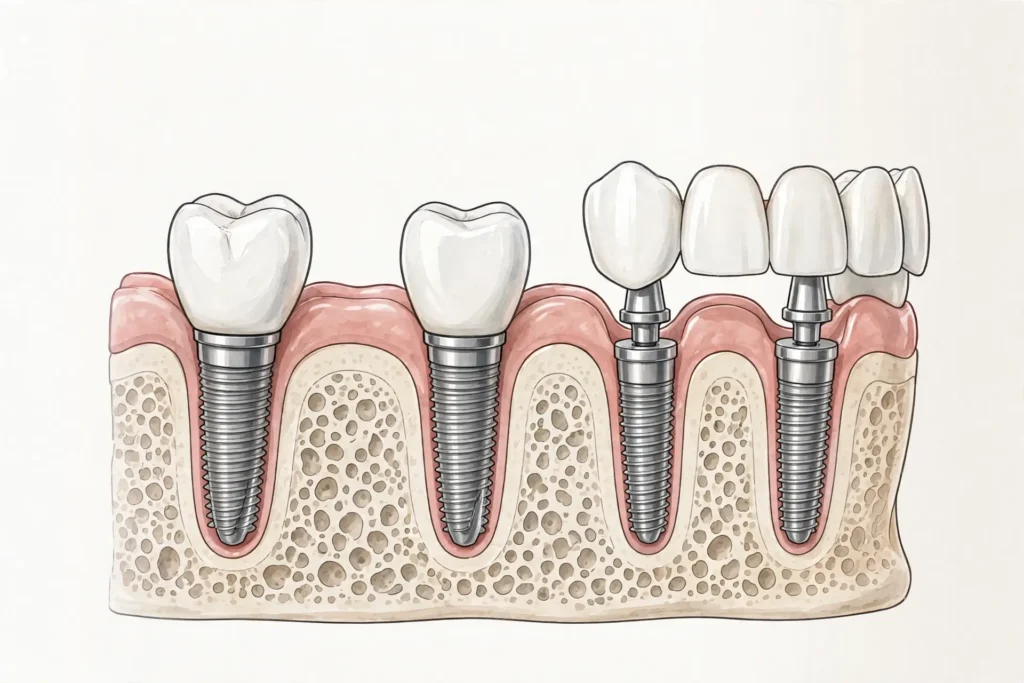
A dental implant replaces the root portion of a missing tooth and provides a stable foundation for a dental crown. Because the implant is placed directly into the jawbone, the neighboring teeth generally do not need to be altered to support the replacement tooth.

Implants can also help maintain the jawbone around the missing tooth by providing stimulation similar to a natural tooth root.

Traditional Bridges

A traditional dental bridge replaces a missing tooth by using the teeth on either side of the space as support. These neighboring teeth are typically reshaped to accommodate the bridge.

Because a traditional bridge does not replace the missing tooth root, it does not provide the same stimulation to the underlying jawbone.

Comparing Your Options

Traditional Bridge

  • Uses neighboring teeth to support the replacement tooth
  • Requires the supporting teeth to be reshaped
  • Does not replace the missing tooth root

Dental Implant

  • Replaces the root of the missing tooth
  • Typically allows neighboring healthy teeth to remain intact
  • Provides a stable foundation for a replacement crown
  • Can help support the surrounding jawbone
 

Your dentist or specialist can evaluate your individual situation and discuss the benefits, considerations, and long-term expectations of each option to help you determine which restoration is right for you.
Signs you may need treatment
Single Missing Tooth
Multiple Missing Teeth
Loose Denture / Bridge

Difficulty Chewing & Smiling

What to expect

1

Diagnose

We check your bone quality and quantity, overall health, and whether you need single or multi-tooth replacement. Age is not a factor, but smoking, diabetes, and radiation therapy can lower success rate. We also evaluate if you need bone grafting if tooth was removed many years ago and bony ridge is thin.

2

Treat

Using most recent advances, Dr. Farhadian places single stage implants that do not require second procedure to uncover them, but require minimum eight weeks healing before artificial teeth are placed. There are even situations where implant can be placed at same time as tooth extraction – minimizing surgical procedures. For multi-tooth, implants are placed to support multiple crowns without affecting adjacent teeth.

3

Restore

Time is allowed for bone to heal and grow around implant. Bone bonds with titanium, creating strong foundation. A support post (abutment) is then placed and new replacement tooth (crown) is placed on top. In many cases temporary replacement can be attached immediately. For multi-teeth, a variety of treatment options are available. Final prosthesis is made by your restorative dentist. You can smile, eat anything, and laugh again.

Common questions

What is a single tooth implant?
When you lose one tooth, you lose root and crown. Implant replaces root with small titanium implant anchored in jaw. After bone bonds with titanium, abutment and new crown are placed on top. It looks, feels, and functions like a natural tooth without affecting neighboring teeth like a bridge would.
For several missing teeth, multiple implants can be placed to support individual crowns or a bridge. If all teeth are missing, a variety of options are available to support replacement teeth. Single stage implants are used, requiring 8 weeks healing, and sometimes implants can be placed same time as extraction.
Single stage implants do not require second uncovering procedure but need minimum eight weeks healing before artificial teeth are placed. In some cases temporary tooth can be attached immediately after placement. After graft has fused to pre-existing bone (if grafting needed), ridge is re-entered and implant placed, then bone bonds with implant.
Dental implant placement is a team effort. Dr. Farhadian performs actual implant surgery, initial extractions, and bone grafting if necessary. Your restorative dentist fits and makes permanent prosthesis and any temporary prosthesis needed during process.
Yes, titanium is time-tested material used for artificial joints. Bone bonds with titanium creating strong foundation. Implants allow you to smile, eat anything, and enjoy life without feeling part of body missing. Smoking, diabetes, and radiation can lower success rate, so we evaluate carefully.