You’ve lost a tooth, and your dentist told you it needs to be replaced. Now you’re weighing two very different options: a dental implant or a bridge. Both work, but they’re not interchangeable-and the right choice depends on your bone health, budget, timeline, and how long you want the solution to last.
This is one of the most common decisions we help patients with across the Dallas-Fort Worth area. Here’s a clear look at the real differences.
Dental Implants vs Bridges: Key Differences
| Factor | Dental Implant | Bridge |
|---|---|---|
| Lifespan | 20+ years (often lifetime) | 10-15 years |
| Treatment Time | 3-6 months (healing required) | 2-3 weeks |
| Cost | $3,000-$6,000 per tooth | $2,500-$5,000 (3-unit bridge) |
| Adjacent Teeth | No impact | Must grind down two healthy teeth |
| Bone Preservation | Prevents bone loss | Bone loss continues over time |
| Maintenance | Brush and floss normally | Requires special flossing tools |
Costs and timelines vary by case. Your exam will determine what applies to you.
How Dental Implants Work
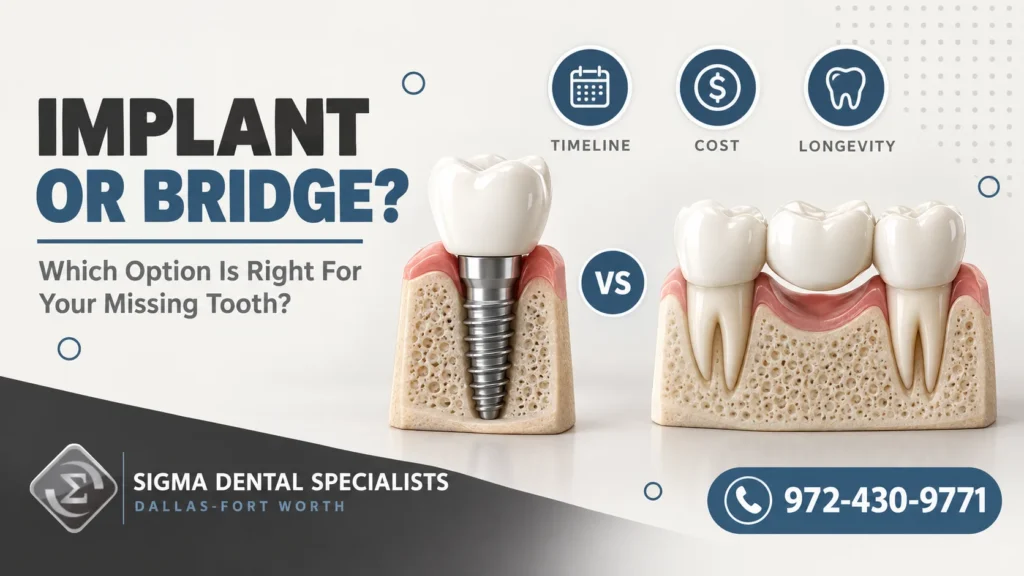
A dental implant is a titanium post surgically placed into your jawbone. It acts as an artificial tooth root. After 3-6 months of healing, a crown is attached to the post.
The big advantage? The implant fuses with your bone, which stops the bone deterioration that naturally happens after tooth loss. It’s also a standalone restoration-your neighboring teeth aren’t touched.
The downside: it takes time. You need sufficient bone density, and if you don’t have it, you may need bone grafting first. That adds months to the timeline and cost to the treatment.
How Dental Bridges Work
A bridge is a three-unit restoration: a fake tooth in the middle, anchored by crowns cemented onto the two adjacent teeth. Your dentist grinds down those neighboring teeth, takes an impression, and a lab fabricates the bridge.
The advantage? Speed. You can have a bridge completed in two or three appointments over a few weeks. No surgery, no waiting for bone healing.
The downside? You’re permanently altering two healthy teeth. And because there’s no root stimulating the bone underneath the missing tooth, the bone continues to shrink over time. Bridges also have a shelf life-most need replacement after 10-15 years.
When an Implant Is the Better Choice
- You have adequate bone density or are willing to undergo bone grafting if needed
- The teeth on either side of the gap are healthy and unrestored-you don’t want to damage them
- You want a long-term solution that preserves your jawbone
- You’re not in a rush and can wait 3-6 months for the full treatment
- You’re looking for something that feels and functions like a natural tooth
When a Bridge Is the Better Choice
- The neighboring teeth already have large fillings or crowns-they’ll need crowns eventually anyway
- You don’t have enough bone for an implant and aren’t interested in grafting
- You need the gap filled quickly for an event or professional reason
- You have certain health conditions that complicate implant surgery (uncontrolled diabetes, recent radiation to the jaw)
- Cost is a primary concern and you need a functional solution now
Cost Considerations in Texas
Across Dallas-Fort Worth, a single implant often falls between $3,000 and $6,000, and a three-unit bridge between $2,500 and $5,000. The final number depends on your case, including whether bone grafting is needed and who completes the final crown.
Insurance may cover part of a bridge, while coverage for implants varies widely by plan. When you factor in how long each option can last, implants can come out more economical over time, though that depends on the individual. You can find details on insurance and financing on our site, and our team can walk you through your options.
What Happens If You Do Nothing
Some patients ask if they really need to replace the tooth at all. The short answer: yes, unless it’s a back molar with no opposing tooth.
When you leave a gap, the adjacent teeth start to shift and tip into the space. The opposing tooth can over-erupt. This creates bite problems, makes cleaning harder, and often leads to more tooth loss down the road.
Frequently Asked Questions
How long does an implant procedure take?
The implant placement itself takes about an hour. The full process-from placement to final crown—takes 3-6 months because the bone needs time to fuse with the implant.
Are dental implants painful?
Most patients report less discomfort than expected. We use local anesthesia during placement, and sedation options are available. Post-op soreness is manageable with over-the-counter pain relievers.
Can a bridge be replaced with an implant later?
Yes, but the two teeth that were crowned for the bridge will still need crowns. The implant would only replace the middle tooth.
Do implants ever fail?
Implant success rates are over 95%. Failures usually happen in the first few months due to poor bone integration, infection, or smoking. Once an implant is fully healed, it’s extremely stable.
Ready to Replace a Missing Tooth in DFW?
Whether you choose an implant or a bridge, the most important thing is that you make an informed decision with a specialist who can evaluate your specific situation.
At Sigma Dental Specialists, our board-certified periodontists will walk you through your options, show you what’s possible with your bone and gum health, and help you choose the solution that fits your goals and timeline.
Call us at 972-430-9771 or schedule your appointment online. We see patients at 9 locations across Dallas-Fort Worth.