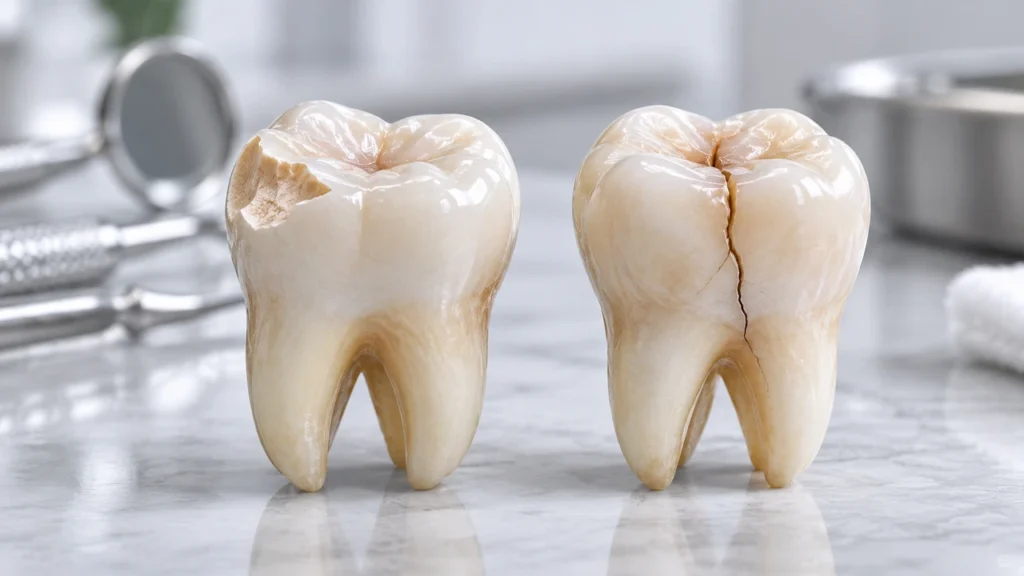
You bit down on something hard and felt a sharp pain. Now you’re looking at your tooth in the mirror trying to figure out what just happened. The difference between a cracked tooth and a chipped tooth isn’t just cosmetic it determines whether you need emergency treatment or can wait for a regular dental appointment.
Here’s what you’re actually dealing with and when to call a specialist.
The Key Differences Between Cracked and Chipped Teeth
| Factor | Chipped Tooth | Cracked Tooth |
|---|---|---|
| What Happened | Piece of enamel broke off | Fracture line extends into tooth structure |
| What You See | Visible missing piece, usually on edge or corner | May see a hairline, or nothing visible at all |
| Pain Level | Usually minimal or none | Sharp pain when biting, sensitivity to temperature |
| Urgency | Schedule regular appointment | See specialist within 24-48 hours |
| Typical Treatment | Bonding, veneer, or smoothing | Root canal, crown, or extraction depending on severity |
How to Tell If Your Tooth Is Chipped
A chipped tooth is usually straightforward. You can see where a piece of enamel broke off, typically on the biting edge or corner of a front tooth. The damage is surface-level.
Common signs include a rough edge you can feel with your tongue, a small visible gap or missing corner, and maybe some sensitivity if the chip exposed dentin underneath. Most chips don’t hurt much because they don’t extend deep into the tooth.
Your general dentist can handle most chips with cosmetic bonding or a veneer. If the chip is tiny and doesn’t bother you, sometimes we just smooth the edge.
How to Tell If Your Tooth Is Cracked
Cracked teeth are trickier because you often can’t see the damage. The fracture line runs vertically through the tooth structure, and depending on how deep it goes, it can be a dental emergency.
Warning Signs of a Cracked Tooth
- Sharp pain when you bite down that disappears when you release pressure
- Sensitivity to hot or cold that lingers after the stimulus is gone
- Pain that comes and goes, making it hard to pinpoint which tooth hurts
- Discomfort when eating but not constant throbbing
The intermittent pain is the giveaway. When you bite down, the crack opens slightly and irritates the pulp inside the tooth. When you release, the crack closes and the pain stops. This flexing motion is what makes cracked teeth so uncomfortable and why they need immediate attention.
Why Cracked Teeth Need Specialist Care
Once a tooth cracks, the fracture doesn’t heal it only gets worse. Every time you chew, the crack spreads deeper into the tooth structure. Left untreated, the crack can reach the root or allow bacteria to enter the pulp and cause an infection.
Board-certified endodontists diagnose cracks using specialized equipment like fiber-optic lights and microscopes that general dentists don’t typically have in-office. We determine whether the tooth can be saved with a root canal and crown or if it needs extraction.
What to Do Right Now
If you think you have a chip, avoid chewing on that side and call your dentist within a few days. Rinse with warm salt water if the edge is irritating your tongue.
If you suspect a crack, treat it as urgent. Call a specialist today. While you’re waiting for your appointment, stick to soft foods, avoid extreme temperatures, and don’t chew on the affected side. Over-the-counter pain relievers can help, but they won’t fix the underlying problem.
Common Causes of Both
Chips and cracks often happen from the same situations. Biting hard objects like ice, popcorn kernels, or hard candy is the most common culprit. Teeth with large old fillings are more prone to cracking because the filling weakens the remaining tooth structure.
Grinding your teeth at night gradually weakens enamel and creates microscopic stress fractures that eventually give way. Trauma from sports or accidents can cause either, depending on the angle and force of impact.
Frequently Asked Questions
Can a chipped tooth turn into a cracked tooth?
Not directly, but a chip that exposes the underlying dentin can make that area more vulnerable to cracking later. If you ignore a chip and keep chewing on it, you might develop a crack from the weakened structure.
Will a cracked tooth show up on an X-ray?
Usually no. Most cracks run vertically, and X-rays show horizontal slices. We diagnose cracks through clinical examination, bite tests, and visual inspection under magnification.
How much does treatment cost?
Chipped tooth bonding typically costs $300-600 at a general dentist. A cracked tooth requiring root canal therapy and crown runs $2,000-3,500 total. Most dental insurance covers a portion of both.
Can I just leave a small chip alone?
If it’s truly tiny, not sharp, and doesn’t hurt, some people do. But even small chips can trap bacteria and lead to decay, or develop into bigger problems if the weakened enamel breaks further. At minimum, have your dentist evaluate it.
Is a cracked tooth always painful?
Not always, especially in the early stages. Some cracks cause no symptoms until they extend deep enough to affect the nerve. That’s why regular dental checkups matter — we can catch cracks before they become painful emergencies.
Ready to get started?
Sigma Dental Specialists is here to help with cracked tooth vs chipped tooth. Reach out today and we’ll walk you through your options, answer your questions, and book a time that works for you.
Call 972-430-9771 or visit Sigma Dental Specialists to schedule your appointment.