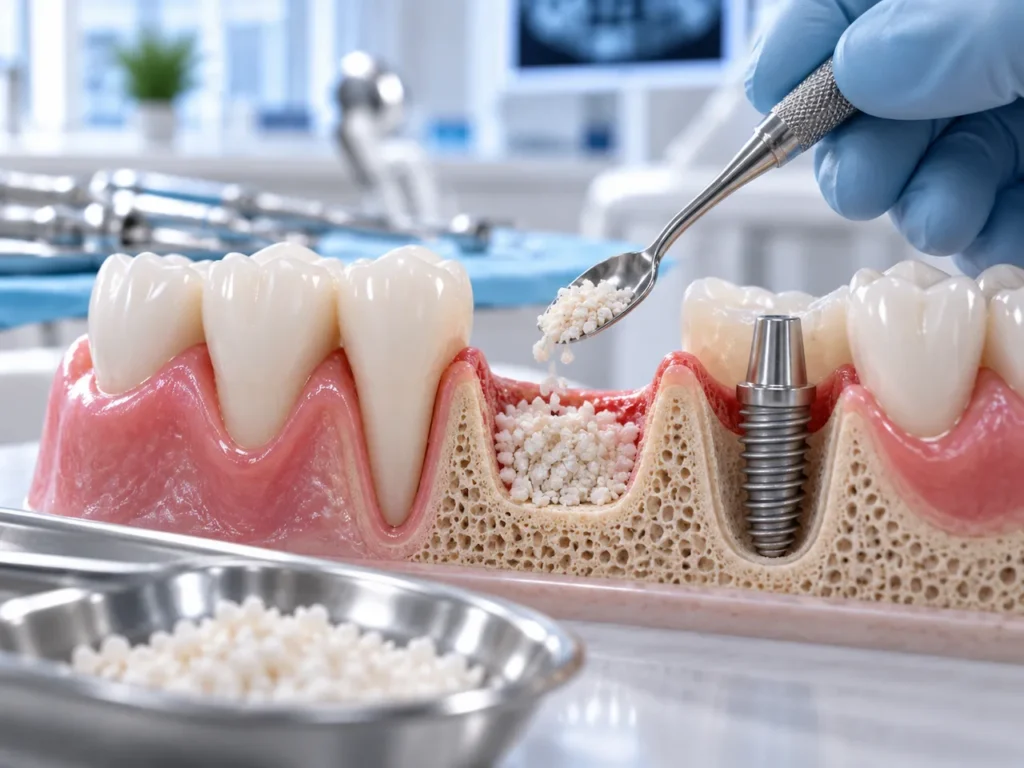
Your dentist just told you that you need a bone graft before your dental implant, and you’re wondering if it’s actually necessary or if there’s a way around it. Here’s the truth: about 50% of implant patients need some form of bone grafting, and whether you’re one of them depends entirely on the current condition of your jawbone.
Let me walk you through exactly when a bone graft is required, what your options look like, and what happens if you skip it.
When You Actually Need a Bone Graft Before Implants
A dental implant needs at least 1-2mm of bone surrounding it on all sides to succeed long-term. If your jawbone doesn’t meet that threshold, a graft isn’t optional it’s the foundation that keeps your implant from failing.
Situations That Require Bone Grafting
- Tooth has been missing for more than 6-12 months — your jawbone begins deteriorating almost immediately after tooth loss
- Tooth was lost due to infection or gum disease — the infection often destroys surrounding bone before extraction
- Upper back teeth replacements near the sinus cavity — the bone here is naturally thinner and often needs augmentation
- Trauma or injury caused bone loss in the area
- You have naturally thin bone structure — some patients simply don’t have enough bone density genetically
We use a CT scan to measure your bone in three dimensions before planning any implant. If the scan shows insufficient bone volume, we discuss bone grafting for implants as part of your treatment plan.
Types of Bone Grafts Used for Dental Implants
Not all grafts are the same. The type you need depends on how much bone you’re missing and where the implant will go.
| Graft Type | When It’s Used | Healing Time |
|---|---|---|
| Socket preservation | Placed immediately after extraction to prevent bone loss | 3-4 months |
| Ridge augmentation | Rebuilds width and height of the jawbone | 4-6 months |
| Sinus lift | Adds bone to upper jaw beneath the sinus cavity | 4-6 months |
| Block bone graft | Severe bone loss requiring larger bone sections | 6-9 months |
Most patients need either a socket preservation graft or a ridge augmentation. We use a combination of synthetic bone material, processed donor bone, or your own bone depending on the situation.
What Happens If You Skip the Bone Graft
I’ll be direct: placing an implant in insufficient bone is a setup for failure. The implant may initially feel stable, but within months to a few years, it will loosen, become infected, or fall out entirely. You’ll lose both the implant and more bone in the process, making future treatment harder and more expensive.
Timeline: Bone Graft to Final Implant
The most common question we hear is how long the entire process takes. Here’s the realistic timeline:
- Bone graft procedure: 1-2 hours depending on graft size
- Healing period before implant placement: 3-6 months
- Implant placement: 1-2 hours
- Healing before final crown: 3-4 months
Yes, that means 6-10 months total from graft to finished tooth. But rushing the process by placing an implant before the graft has fully healed leads to a much higher failure rate.
Can You Get an Implant and Bone Graft at the Same Time?
Sometimes, yes. If you need only a small amount of bone typically just to fill minor gaps around the implant we can place the graft and implant together. This works when there’s enough existing bone to stabilize the implant initially.
For moderate to severe bone loss, the graft needs to heal first. Learn more about the implant placement process and what to expect at each stage.
Frequently Asked Questions
How painful is a bone graft for dental implants?
Most patients describe the discomfort as similar to a tooth extraction. We use local anesthesia during the procedure, and you’ll have swelling and soreness for 3-5 days after. Prescription pain medication manages this effectively for the first few days, then over-the-counter options are usually enough.
Does insurance cover bone grafting for implants?
It depends on your plan. Some dental insurance covers a portion if the graft is deemed medically necessary, but many classify implants and related procedures as cosmetic. We verify coverage before treatment and offer financing options for out-of-pocket costs.
What is the success rate of bone grafts for dental implants?
Bone grafts have a success rate above 95% when performed by a board-certified periodontist. Implant success depends more on factors like your overall health, smoking status, and oral hygiene after placement.
Can a bone graft fail?
Yes, though it’s uncommon. Smoking is the biggest risk factor it restricts blood flow and prevents proper healing. Infection, inadequate post-op care, or placing an implant too soon can also cause graft failure.
Are there alternatives to bone grafting for dental implants?
In some cases, yes. Zygomatic implants anchor into the cheekbone instead of the jaw, bypassing the need for grafting in the upper jaw. Another option is All-on-4 implants, which use angled placement to maximize existing bone. However, these alternatives aren’t suitable for single-tooth replacements.
Ready to get started?
Sigma Dental Specialists is here to help with bone graft before dental implants. Reach out today and we’ll walk you through your options, answer your questions, and book a time that works for you.
Call 972-430-9771 or visit Sigma Dental Specialists to schedule your appointment.